Direct Answer: GDPR (General Data Protection Regulation) is a European Union law that gives individuals control over their personal data. It requires companies to get clear permission before collecting personal information, tells them how long they can keep it, and gives people the right to ask for their data to be deleted. As of 2026, violations have resulted in more than €7 billion in fines.
Direct Answer: GDPR (General Data Protection Regulation) is a European Union law that gives people control over their personal data. It requires companies to get your permission before collecting your information, lets you ask for your data to be deleted, and punishes violations with fines up to €20 million or 4% of a company’s global revenue whichever is higher.
What is GDPR simple explanation it’s the question millions of people type into Google every year, usually right after getting one of those cookie pop-ups or hearing about a massive data breach on the news. You handed a website your email address, your name, maybe even your home address nd now you want to know what protections actually exist. The short answer: if you’re dealing with an EU-based company (or a company that serves EU residents), GDPR gives you real, enforceable rights over your personal data. And those rights have teeth. If data brokers are already buying and selling your information, it helps to know how to opt out of data brokers as a first step.
The Short Version
- GDPR is an EU law (in effect since May 2018) that controls how companies collect, store, and use your personal data.
- It applies to any company that handles the data of people in the EU even if the company is based in the United States, Japan, or anywhere else.
- Under GDPR, individuals generally have the right to access, correct, and delete their personal data.
- Companies that break these rules face fines of up to €20 million or 4% of their global annual revenue, whichever is higher.
What “GDPR” Actually Means Under the Law
Let’s break down the name first.
GDPR stands for General Data Protection Regulation. It’s a regulation not a guideline, not a suggestion passed by the European Union in 2016 and enforced starting May 25, 2018. The full legal name is Regulation (EU) 2016/679.
A regulation in EU law is different from a directive. A directive tells EU countries “figure out how to make this happen.” A regulation says “this is the law, right now, across all member states.” That distinction matters because GDPR applies the same way in Germany, France, Italy, Spain, and all 27 EU countries. No country gets to water it down.
Here’s what GDPR actually does in plain terms:
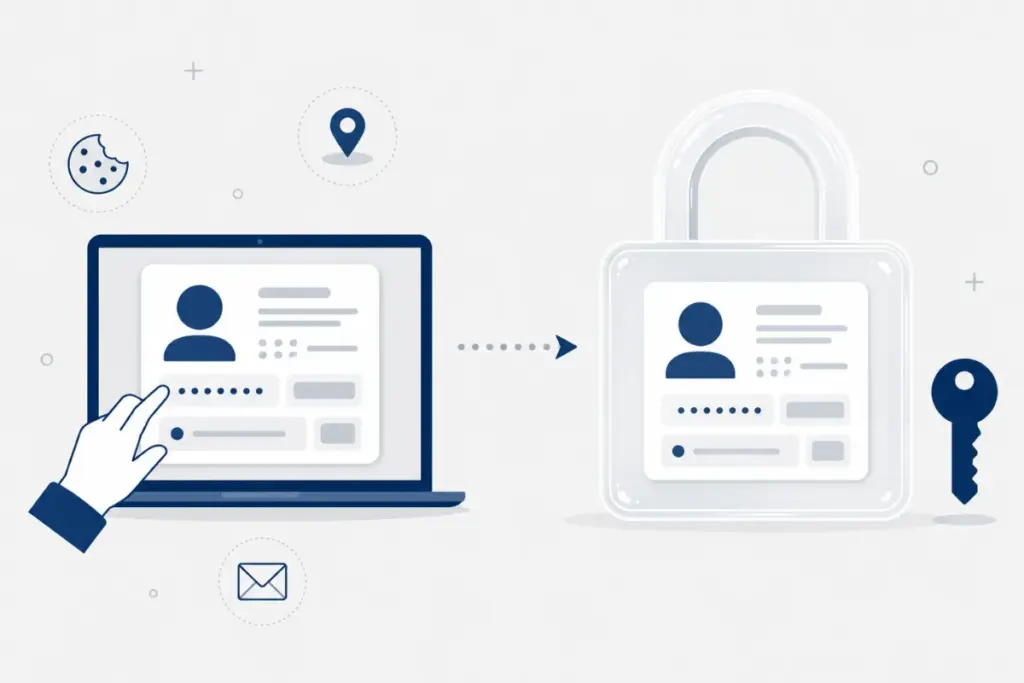
It defines “personal data” broadly. Under GDPR, personal data means any information that can identify a living person directly or indirectly. Your name, email address, IP address, location data, cookie identifiers, and even your browsing history can all count as personal data. This definition is much wider than what most people expect.
It requires a legal reason to collect your data. Companies can’t just grab your information because they feel like it. Under Article 6 of GDPR, they need a lawful basis a legal justification for processing your data. The six lawful bases include: your consent, a contract with you, a legal obligation, protecting someone’s vital interests, a public task, or the company’s legitimate interests (balanced against your rights). “We want to sell ads” is not automatically a valid reason on its own.
It gives you specific rights over your data. This is where GDPR gets personal. The regulation spells out eight core rights that apply to anyone whose data is being processed. These rights include:
- Right of access (Article 15) You can ask any company whether they hold your data and get a copy of it.
- Right to rectification (Article 16) If your data is wrong, you can ask them to fix it.
- Right to erasure (Article 17) Also called the right to be forgotten. You can ask a company to delete your personal data in many situations.
- Right to data portability (Article 20) You can ask a company to hand over your data in a format you can take to a competitor.
- Right to object (Article 21) You can tell a company to stop using your data for direct marketing. They must comply immediately no exceptions.
These rights are not theoretical. Under EU law, companies must respond to most data requests within 30 days, and the response must be free of charge unless the request is excessive or repeated.
It applies outside the EU, too. One of the most misunderstood parts of GDPR is its extraterritorial scope meaning it reaches beyond EU borders. If a company in California, Tokyo, or São Paulo collects data from someone located in the EU, GDPR applies to that company. This is spelled out in Article 3 of the regulation. Several non-EU companies have already been fined under GDPR, including Clearview AI (fined €30.5 million by the Dutch data protection authority in 2024) and TikTok (fined €530 million by Ireland’s Data Protection Commission in 2025).
Real-World Examples
GDPR isn’t abstract. Here are three situations where it shows up in everyday life.
The Cookie Pop-Up You Click 20 Times a Day
Every time a European website shows you a box asking whether you accept cookies, that’s GDPR in action. Under the regulation (and the related ePrivacy Directive), websites must get your consent before placing non-essential cookies like tracking cookies used for advertising on your device.
The law says consent must be freely given, specific, informed, and unambiguous. That means pre-ticked boxes don’t count. Making it harder to reject cookies than to accept them doesn’t count either. France’s data protection authority, CNIL, fined Google €100 million for designing a cookie banner that made rejection more difficult than acceptance.
The Data Breach Email
If a company experiences a data breach an unauthorized access to personal data GDPR requires them to notify their national supervisory authority within 72 hours if the breach poses a risk to people’s rights. If the risk is high, they must also notify the affected individuals directly.
This is why you sometimes receive emails saying “we experienced a security incident.” That notification isn’t a courtesy in the EU, it’s a legal requirement under Article 33 of GDPR.
The “Delete My Account” Request
Someone in Berlin signs up for a social media platform, uses it for a year, then decides to leave. Under GDPR’s right to erasure, they can ask the platform to delete all their personal data. The platform generally must comply within 30 days and confirm that the data has been removed. If they don’t, the individual can file a complaint with their country’s data protection authority (DPA) the government agency responsible for enforcing GDPR.
As of 2026, European data protection authorities receive more than 440 breach notifications per day a 22% increase year-over-year. Enforcement is not slowing down.
What People in This Situation Typically Do
If you want to exercise your rights under GDPR, here’s what many people do in practice:
1. Check whether GDPR applies to you. If you’re physically located in the EU (even temporarily), GDPR protections apply to you regardless of your nationality. If you’re outside the EU, GDPR may still apply to the company you’re dealing with but enforcing your rights becomes harder.
2. Send a data subject access request (DSAR). This is a formal request asking a company what personal data they hold about you. Under Article 15, you don’t need to use legal language or reference specific articles. A simple email saying “I’d like a copy of all personal data you hold about me” is enough. Companies must respond within one month.
3. Ask for your data to be deleted. If you want a company to remove your data, you can submit a right to erasure request under Article 17. The company must comply unless a legal exception applies for example, if they need the data to comply with another law, or to defend a legal claim.
4. File a complaint with a data protection authority. Every EU country has a DPA. In France, it’s the CNIL. In Germany, each state has its own DPA. In Ireland, it’s the Data Protection Commission. If a company ignores your request or handles it poorly, filing a complaint with the relevant DPA is the standard next step. Complaints are free to file, and the DPA has the power to investigate and impose fines.
5. Use opt-out tools for data brokers. Many people discover that data brokers companies that collect, package, and sell personal information hold surprising amounts of data about them. Under GDPR, individuals in the EU can request deletion from data brokers the same way they would from any other company. For those outside the EU, separate laws like California’s CCPA may offer similar (though not identical) rights.
Tools That Can Help
For people who want to take control of their personal data especially when dealing with dozens of data brokers manual requests get overwhelming fast. Some tools help automate this process:
Incogni scans data broker databases on your behalf and sends removal requests automatically. It covers hundreds of data brokers and provides regular status updates. This is particularly useful for anyone who has discovered their personal information listed on people-search sites.
ProtonVPN and ProtonMail are built around privacy by design. ProtonVPN encrypts your internet traffic and doesn’t log your browsing activity, while ProtonMail offers end-to-end encrypted email. Both are based in Switzerland, which has strong privacy laws of its own.
These tools don’t replace your GDPR rights they complement them. The legal protections exist whether or not you use any tool. But for people who want to actively reduce their data footprint, they can save significant time.
How GDPR Enforcement Actually Works in 2026
GDPR enforcement has changed dramatically since the regulation first took effect in 2018. In the early years, fines were relatively small and infrequent. That’s no longer the case.
As of mid-2026, cumulative GDPR fines across the EU have passed the €7 billion mark. More than €1.2 billion in fines were issued in 2025 alone. The largest single fine on record €1.2 billion was imposed on Meta Platforms Ireland in May 2023 for transferring EU users’ data to the United States without adequate safeguards.
Spain leads in the number of fines issued, with more than 1,000 individual penalties since 2018. Ireland leads in total fine value (around €4 billion), largely because many major tech companies have their European headquarters there.
Enforcement priorities in 2026 focus on several key areas:
Transparency and information obligations. The European Data Protection Board (EDPB) launched its 2026 Coordinated Enforcement Framework focused specifically on Articles 12, 13, and 14 of GDPR the rules about how companies must inform people about data collection. Twenty-five data protection authorities across the EU are participating.
International data transfers. Moving personal data outside the EU remains one of the most heavily penalized violations. Despite the EU-US Data Privacy Framework adopted in 2023, transfers that fall outside its scope or rely on outdated safeguards continue to attract serious fines.
AI and automated decision-making. With the EU AI Act reaching full enforcement for high-risk systems in August 2026, regulators are paying close attention to how AI systems process personal data. Italian authorities have already started treating AI model training data under the same legal framework as other forms of data processing.
The bottom line: GDPR enforcement is not winding down. It’s accelerating in both frequency and financial severity.
GDPR vs. Other Privacy Laws: How It Compares
GDPR isn’t the only data privacy law in the world, but it remains the most influential.
In the United States, there is no single federal privacy law equivalent to GDPR. Instead, privacy protections come from a patchwork of state laws. California’s CCPA (California Consumer Privacy Act, 2018, amended by CPRA in 2023) is the most well-known, giving California residents the right to know what data companies collect, to delete it, and to opt out of its sale. However, CCPA is narrower than GDPR in several ways it applies only to for-profit businesses above certain revenue thresholds and uses an opt-out model rather than GDPR’s opt-in consent requirement.
As of January 2026, 19 US states have enacted their own privacy laws, including Indiana, Kentucky, and Rhode Island. But these laws vary significantly in scope, definitions, and enforcement mechanisms.
In the United Kingdom, the UK GDPR continues to apply after Brexit, operating alongside the Data Protection Act 2018. The UK’s Data (Use and Access) Act 2025 introduced some modifications including a concept called “recognised legitimate interests” and simplified international transfer rules but the core data subject rights remain largely the same as under EU GDPR.
Globally, more than 144 countries now have data protection laws in place. Many including Brazil’s LGPD, South Korea’s PIPA, and India’s Digital Personal Data Protection Act (2025) were directly influenced by GDPR’s framework.
Related Articles
- How to Opt Out of Data Brokers 2026 Guide
- Can Companies Legally Sell Your Personal Data?
- The Right to Be Forgotten: How to Request Deletion
Frequently Asked Questions
Does GDPR apply to me if I live outside the EU?
GDPR protects people who are located in the EU at the time their data is collected regardless of citizenship. If you live in the United States or another non-EU country, GDPR does not directly protect you. However, the companies you deal with may still follow GDPR rules if they also serve EU customers. For US residents, state laws like California’s CCPA may provide similar (though not identical) protections.
What happens to a company that violates GDPR?
Penalties fall into two tiers. Less serious violations like failing to keep proper records carry fines of up to €10 million or 2% of global annual revenue. More serious violations like processing data without a lawful basis or ignoring data subject rights can reach €20 million or 4% of global annual revenue, whichever is higher. Beyond fines, regulators can also order companies to stop processing data entirely, which can be even more damaging than the financial penalty.
How is GDPR different from CCPA?
Both laws give people more control over their personal data, but they differ in structure and scope. GDPR uses an opt-in model companies must get consent before collecting data in most cases. CCPA uses an opt-out model companies can collect data by default, and consumers must actively request to opt out. GDPR applies to any organization that processes EU residents’ data, regardless of size. CCPA applies only to for-profit businesses that meet specific revenue or data-volume thresholds. GDPR’s maximum fines are also significantly higher.
Can I ask any company to delete my data under GDPR?
If you’re located in the EU, you can request deletion from any company that holds your personal data under Article 17’s right to erasure. However, the right is not absolute. Companies can refuse if they need the data to comply with another legal obligation, to exercise freedom of expression, for public health reasons, or to establish or defend legal claims. In practice, most routine deletion requests from consumers are granted within 30 days.
What This All Means for You
Understanding what GDPR is in simple terms comes down to this: it’s a law that says your personal data belongs to you, not to the companies that collect it. It gives people in the EU (and increasingly, people worldwide through laws inspired by GDPR) real tools to control how their information is used, stored, and shared.
The regulation isn’t perfect. Enforcement is uneven across countries. Cookie consent fatigue is real. And many people still don’t know they have these rights. But GDPR remains the strongest set of personal data protections anywhere in the world and as of 2026, regulators are enforcing it more aggressively than ever.
If any of this affects your situation, the best place to start is with your country’s data protection authority. They can tell you exactly how to file a complaint or request your data. Many also publish plain-language guides in multiple languages.
This article is for educational purposes only and does not constitute legal advice. Laws vary by jurisdiction and change frequently. For advice specific to your situation, consult a qualified attorney.

Sources & Further Reading
- EUR-Lex Full text of Regulation (EU) 2016/679 (GDPR) The official legal text of GDPR, including all articles and recitals
- European Commission Data Protection Official EU Commission page on GDPR rights and enforcement
- European Data Protection Board (EDPB) The EU body coordinating GDPR enforcement across member states
- UK Information Commissioner’s Office (ICO) UK GDPR guidance and resources
- FTC.gov Privacy and Security US Federal Trade Commission guidance on data privacy (for US-specific comparison)