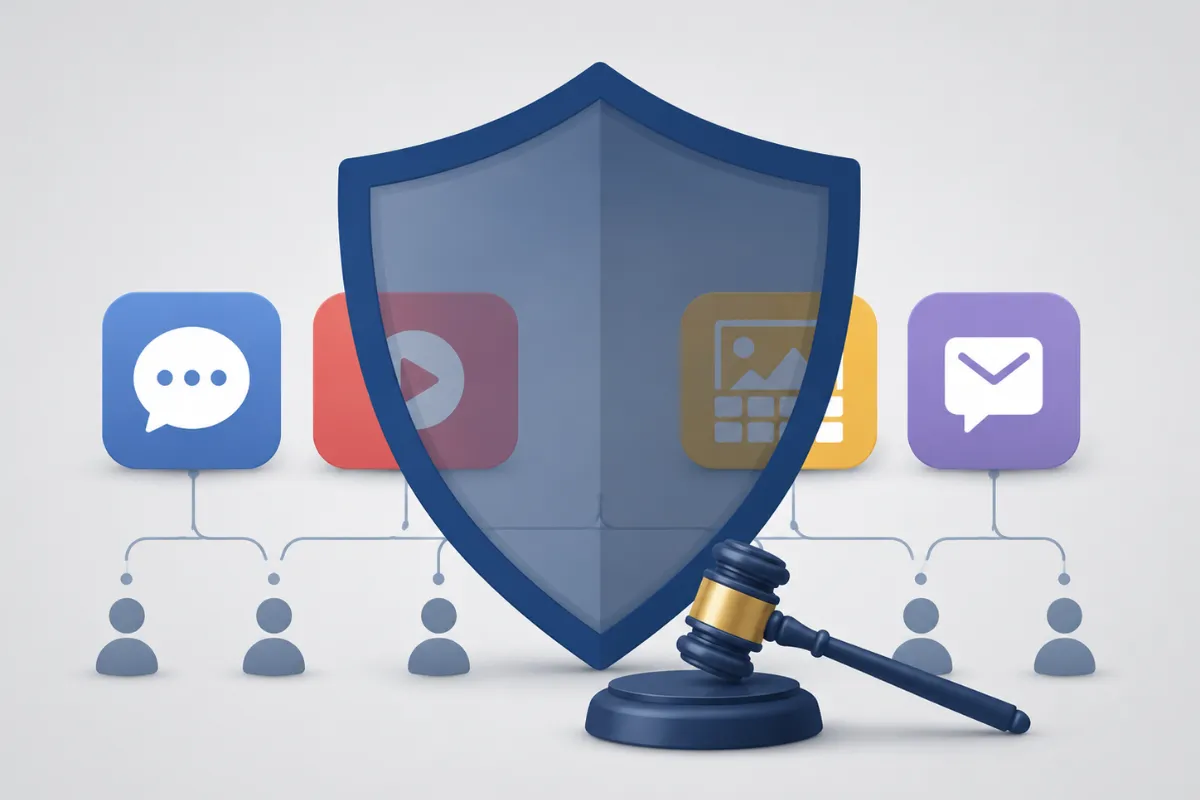
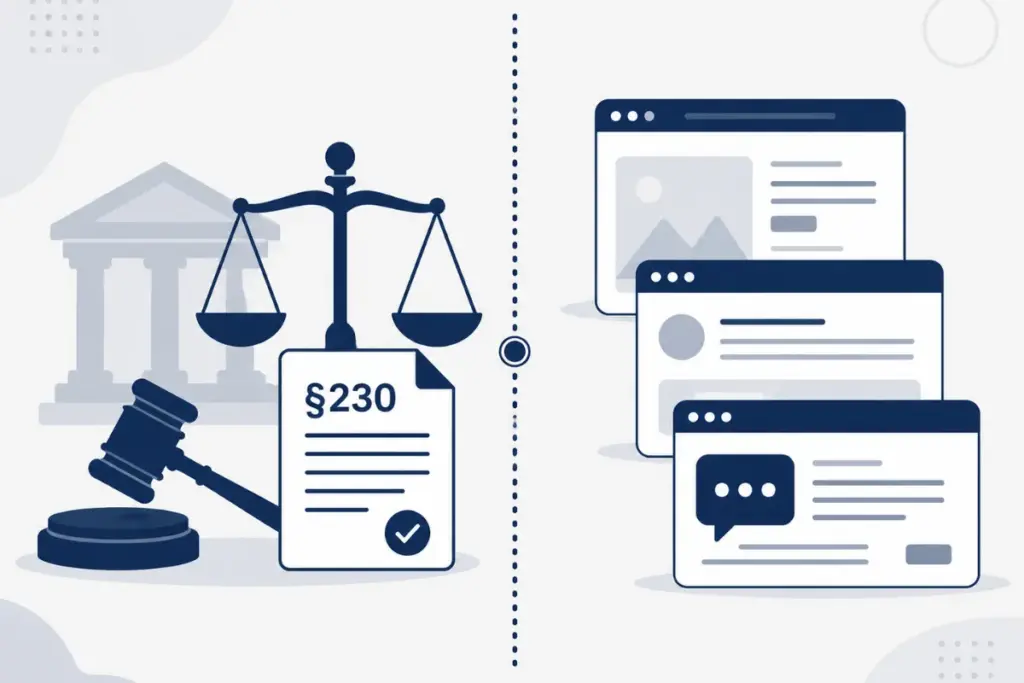
Direct Answer: Section 230 is a United States federal law that protects websites and social media platforms from being sued over content posted by their users. It also allows platforms to moderate content without facing legal consequences. Without it, much of the internet as we know it from comment sections to social media feeds would likely not exist.
Section 230 explained in simple terms: it’s the reason you can’t sue Facebook when someone posts something defamatory about you on their platform. Passed in 1996, this single provision of the Communications Decency Act (CDA) has shaped how every major social media company operates. But it’s also one of the most controversial laws in American tech policy, with lawmakers on both sides of the aisle calling for reform or repeal. Whether you’ve been affected by harmful content online or you’re just wondering why platforms seem untouchable, understanding this law matters. For a closer look at what you’re agreeing to when you sign up for these services, see our breakdown on Terms of Service What You’re Actually Agreeing To.
The Short Version
- Section 230 is a U.S. law that shields websites from lawsuits over things their users post but not over content the platform creates itself.
- It has two main parts: one that blocks most lawsuits treating platforms as publishers, and one that protects platforms when they remove offensive material.
- The law does not cover everything. Federal criminal law, intellectual property claims, and sex trafficking offenses fall outside its protection.
- Major reform efforts are underway in the U.S. Congress, with multiple bills proposing to limit or repeal Section 230 entirely.
What Section 230 Actually Means Under the Law
In the United States, Section 230 of the Communications Act of 1934 (added by the Communications Decency Act of 1996, codified at 47 U.S.C. § 230) contains 26 words that changed the internet:
“No provider or user of an interactive computer service shall be treated as the publisher or speaker of any information provided by another information content provider.”
In plain English, that means platforms like X (formerly Twitter), YouTube, Reddit, and Facebook are not legally treated as the author of what their users post. If someone writes a defamatory review on Yelp, under U.S. law, Yelp generally cannot be sued for publishing it only the person who wrote it can face legal action.
The law has two key sections:
Section 230(c)(1) the “publisher immunity” provision stops most civil lawsuits that would hold a platform responsible for user-generated content. Courts have interpreted this broadly. In the landmark 1997 case Zeran v. America Online, Inc., a federal appeals court ruled that this provision bars lawsuits that try to hold a service provider liable for editorial decisions like whether to publish, remove, or alter content.
Section 230(c)(2) the “Good Samaritan” provision protects platforms when they voluntarily remove material they consider obscene, violent, harassing, or “otherwise objectionable.” This is the part that allows content moderation without legal risk.
What the law does NOT protect
Section 230 is not absolute. Under U.S. federal law, these exceptions apply:
- Federal criminal law platforms can still face criminal prosecution.
- Intellectual property copyright and trademark claims remain enforceable (this is why the DMCA takedown system exists separately).
- Sex trafficking the FOSTA-SESTA Act (2018) carved out an exception making platforms liable for content that facilitates sex trafficking.
- State law states can enforce laws that are consistent with Section 230.
How the EU and UK handle this differently
Section 230 is a U.S.-only law. The European Union takes a different approach through the Digital Services Act (DSA), which took full effect in February 2024. The DSA does not grant broad immunity. Instead, it imposes graduated responsibilities on platforms based on their size requiring transparency reports, content moderation processes, and risk assessments. Very large platforms face the strictest rules, and violations carry fines of up to 6% of global revenue.
In the United Kingdom, the Online Safety Act (2023) requires platforms to remove illegal content and protect children from harmful material, or face enforcement action from Ofcom the UK communications regulator.
The difference is striking: where the U.S. defaults to platform immunity, the EU and UK default to platform accountability.
Real-World Examples
The Gonzalez family and YouTube
In 2015, Nohemi Gonzalez was killed in terrorist attacks in Paris. Her family sued Google, arguing that YouTube’s recommendation algorithm actively promoted ISIS recruitment content. The case reached the U.S. Supreme Court in 2023, but the Court declined to rule on the Section 230 question, leaving the law’s scope unchanged for now.
Social media addiction lawsuits
As of 2026, more than 200 product liability lawsuits have been filed against companies like Meta, TikTok, and Snap. These cases argue that platforms are not being sued over user content, but over design choices addictive features like infinite scroll, algorithmic recommendations, and notification systems that caused harm to children. In one landmark case, the Ninth Circuit ruled in Lemmon v. Snap that Section 230 did not protect Snapchat from litigation over its negligent product design, opening the door for similar claims.
State attorneys general take action
Multiple state attorneys general have filed lawsuits against Meta and TikTok, alleging that these companies violated consumer protection laws. A Massachusetts court ruled in 2024 that Meta’s lawsuit was primarily about Meta’s own conduct not third-party content and denied Section 230 immunity, allowing the case to proceed.
What People in This Situation Typically Do
- Check whether the content is user-generated or platform-created. Section 230 only covers third-party content. If a platform itself created or developed the harmful material, immunity does not apply.
- Look into design-based claims. Recent court decisions suggest that lawsuits targeting a platform’s design choices (rather than specific user posts) may bypass Section 230 protections entirely.
- Report content through the platform’s own process. Under the newly enacted TAKE IT DOWN Act (2025), covered platforms must now remove non-consensual intimate images within 48 hours of receiving a valid request. FTC enforcement began in May 2026.
- Contact a qualified attorney. Platform liability law is evolving rapidly. An attorney can assess whether Section 230 applies to a specific situation, especially given recent case law developments.
- File a complaint with the FTC if a platform fails to comply with the TAKE IT DOWN Act’s removal requirements at TakeItDown.ftc.gov.
Related Articles
- Can Companies Legally Sell Your Personal Data?
- Online Defamation: How to Get Content Removed?
- Terms of Service What You’re Actually Agreeing To
Frequently Asked Questions
What exactly does Section 230 protect platforms from?
Under U.S. law, Section 230 protects platforms from most civil lawsuits based on content posted by their users. It prevents courts from treating platforms as the “publisher or speaker” of user-generated content. However, it does not protect platforms from federal criminal prosecution, intellectual property claims, or sex trafficking-related offenses under FOSTA-SESTA.
Can Section 230 be repealed, and what would happen?
Multiple bills in the 119th Congress (2025–2026) propose either repealing or sunsetting Section 230. The bipartisan Sunset Section 230 Act, introduced by Senators Graham and Durbin, would repeal the law entirely. If repealed without a replacement, platforms could face lawsuits over every piece of user content which critics warn could lead to either mass censorship or the shutdown of user-generated content features altogether.
Does Section 230 apply outside the United States?
No. Section 230 is strictly a U.S. federal law. The European Union regulates platform liability through the Digital Services Act, while the United Kingdom uses the Online Safety Act. Both impose affirmative duties on platforms rather than granting broad immunity. Other countries including Brazil and Australia are also rewriting their own platform liability rules.
Has anyone successfully sued a platform despite Section 230?
Yes. Recent product liability lawsuits have found ways around Section 230 by targeting platform design choices rather than user content. The Ninth Circuit’s Lemmon v. Snap ruling in 2021 allowed claims based on negligent product design to proceed. As of 2026, roughly 1,500 similar cases have moved forward despite Section 230, and a major trial against Meta and YouTube over addictive platform design is underway in Los Angeles.
Understanding section 230 explained in its full context what it covers, where it fails, and how other countries handle the same problem is the first step toward knowing where you stand when something goes wrong online. This is one of the most actively debated laws in American tech policy, and its future will affect everyone who uses the internet.
This article is for educational purposes only and does not constitute legal advice. Laws vary by jurisdiction and change frequently. For advice specific to your situation, consult a qualified attorney.
Sources & Further Reading
- 47 U.S.C. § 230 Full text of Section 230 Cornell Law Institute
- Section 230: An Overview Congressional Research Service Detailed analysis of the law’s scope and judicial interpretation
- Section 230 Electronic Frontier Foundation Overview and key cases
- FTC Take It Down Act Enforcement Platform removal requirements effective May 2026
- Sunset Section 230 Act (S. 3546) Congress.gov Bipartisan repeal bill text