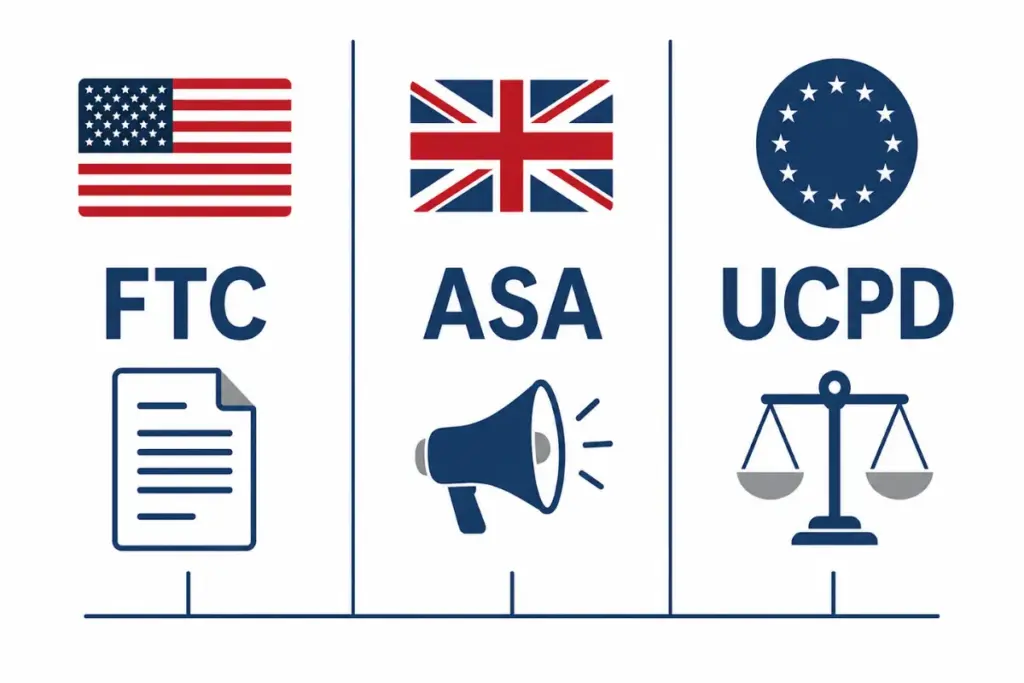
Direct Answer: Under US federal law, the FTC requires influencers to clearly disclose any material connection to a brand including payments, free products, and affiliate commissions. Failing to disclose can lead to civil penalties exceeding $50,000 per violation for both creator and brand. In the UK and EU, similar rules apply under the ASA’s CAP Code and the Unfair Commercial Practices Directive.
Influencer FTC disclosure rules affect every creator who has ever tagged a brand, accepted a free product, or earned a commission from a link and most people posting sponsored content still get the details wrong. Whether someone has a million followers or a thousand, the legal obligations are the same. The consequences range from warning letters to six-figure fines, and regulators on both sides of the Atlantic are paying closer attention than ever. If terms of service already confuse most people, disclosure rules are even easier to overlook.
The Short Version
- In the US, the FTC’s Endorsement Guides (16 CFR Part 255) require that any material connection money, free products, affiliate links, perks be disclosed clearly and immediately in every piece of sponsored content.
- Words like “Ad,” “Sponsored,” or “Paid partnership” count as valid disclosure. Words like “collab,” “thanks,” “sp,” or “partner” alone do not.
- The disclosure must appear in the first two lines of a caption (before the “more” tap) or at the start of a video not buried in hashtags or hidden at the end.
- Both the creator and the brand can face penalties. In the US, fines can exceed $53,000 per violation. In the UK, the CMA can now impose fines of up to 10% of global annual turnover for serious breaches.
What Influencer FTC Disclosure Rules Actually Mean Under the Law
United States: The FTC Endorsement Guides
In the United States, the legal basis for influencer disclosure sits in Section 5 of the FTC Act, which prohibits unfair or deceptive acts in commerce. The FTC’s Endorsement Guides, most recently revised in 2023, spell out what this means for creators and brands.
A material connection is any relationship that could influence how an audience perceives a recommendation. Under FTC guidance, this includes cash payments, free products (even unsolicited PR packages), affiliate commissions, brand trips, event tickets, employment or ownership stakes, and family or personal relationships tied to a promotion.
The FTC applies a standard called “clear and conspicuous” meaning an ordinary viewer, scrolling at normal speed, would notice and understand that the post is sponsored. Terms like “Ad,” “Sponsored,” and “Paid partnership” meet this standard. Terms like “collab,” “ambassador,” “sp,” or “thanks” do not.
Placement matters just as much as wording. The disclosure must appear in the first two lines of a caption before the “more” tap. In video content, the disclosure needs to be stated at the beginning, not flashed in small text at the end.
One detail that catches creators off guard: platform tools alone are not enough. Instagram’s “Paid partnership” tag or TikTok’s branded content toggle can help, but the FTC has made clear these labels do not replace a written or verbal disclosure in the content itself.
United Kingdom: The ASA and CAP Code
In the UK, the Advertising Standards Authority (ASA) enforces the CAP Code, which applies to all influencer marketing content. The ASA recommends using “Ad” or “#ad” at the start of every sponsored post. Terms like “gifted,” “PR trip,” or “affiliate” have been repeatedly ruled insufficient on their own.
An ASA monitoring study found that roughly 43% of influencer ads had no disclosure at all. The ASA has confirmed that influencer transparency remains a priority enforcement area through 2026 and is scaling up AI-based Active Ad Monitoring to identify non-compliant posts.
Since April 2025, enforcement has gained real teeth. The Digital Markets, Competition and Consumers Act (DMCCA, 2024) gave the CMA power to impose fines of up to 10% of global annual turnover for serious or repeated breaches without needing a court order.
European Union: Current Rules and What’s Coming
Across the EU, influencer marketing falls under the Unfair Commercial Practices Directive (UCPD), which prohibits misleading commercial practices. Any form of compensation monetary payment, free products, affiliate links, or gifted trips triggers a disclosure obligation.
A 2024 EU-wide sweep found that 97% of reviewed influencers posted commercial content, but only about 20% systematically disclosed it as advertising. Ireland’s CCPC recently took action against 26 high-profile influencers for failing to include appropriate ad labels.
The European Commission is preparing the Digital Fairness Act, expected in late 2026, which would codify stricter disclosure standards across all member states.
Real-World Examples
The buried hashtag. A fitness influencer in the US posts a workout video featuring a supplement brand. The caption includes 40 hashtags, with “#ad” sandwiched between “#fitspo” and “#grwm” at the very end. Under FTC standards, this does not count as clear and conspicuous disclosure the word technically exists, but it is functionally hidden from an ordinary viewer.
The gifted product with no label. A UK beauty creator receives a free skincare package, posts a review saying “loving this new serum,” and includes no disclosure. Under both the FTC’s Endorsement Guides and the ASA’s CAP Code, free products create a material connection that requires disclosure even when the brand did not ask for a post.
The undisclosed ownership stake. Two YouTube creators in the US promoted a gambling site called CSGO Lotto without disclosing that they owned the company. The FTC settlement required both creators to disclose material connections in all future endorsements establishing that ownership stakes require disclosure, even when content is framed as an organic discovery.
What People in This Situation Typically Do
- Check whether a material connection exists. Many creators ask: “Would my audience care that I received something of value here?” If yes, disclosure is typically required under US, UK, and EU standards.
- Use clear, approved language at the top of every post. In the US, accepted terms include “Ad,” “Sponsored,” or “Paid partnership.” In the UK, the ASA strongly recommends “#ad” at the beginning of a caption. Creators wanting to specify the relationship often write “Ad Gifted” or “Ad Brand Ambassador.”
- Disclose in every format, on every platform. A disclosure in an Instagram caption does not cover the same content reposted as a TikTok or YouTube Short. Each post requires its own visible disclosure.
- Keep records of brand agreements and disclosure compliance. Many creators save screenshots of published posts alongside copies of contracts and briefs. Documented proof of compliance is the strongest defense if questions arise later.
- Review content before publishing. Many marketing teams now require pre-publication review to verify that disclosure language appears correctly. A growing number of brand agreements include clauses allowing payment to be withheld if disclosure is missing.
Tools That Can Help
- DeleteMe A data broker removal service that helps creators and public figures reduce personal data exposure online relevant for influencers managing their digital footprint alongside brand partnerships.
Related Articles
- What Is Section 230 and Why Does It Matter?
- Online Defamation: How to Get Content Removed?
- Terms of Service What You’re Actually Agreeing To
Frequently Asked Questions
Do I need to disclose if a brand gave me a free product?
Yes, under both US and UK rules. The FTC defines a material connection as anything of value including free products, even unsolicited ones. The ASA takes the same position. If a brand sends a product and the creator mentions it, a clear disclosure like “Ad Gifted” is expected regardless of whether the brand asked for a post.
Is #partner or #collab enough disclosure?
Generally, no. The FTC has stated that “partner,” “collab,” “sp,” and “ambassador” are too vague for an ordinary consumer to recognize paid advertising. The ASA has reached similar conclusions. Accepted alternatives include “Ad,” “#ad,” “Sponsored,” or “Paid partnership.”
What happens if I don’t disclose a paid partnership?
In the United States, the FTC can pursue enforcement against both the creator and the brand. Civil penalties can reach over $53,000 per violation, and each non-compliant post counts separately. The FTC typically sends warning letters first, but patterns of non-compliance escalate to formal action. In the UK, the ASA can order content removal, issue public rulings, and refer repeat offenders to the CMA for financial penalties.
Do FTC rules apply to small creators with few followers?
Yes. The FTC does not set a minimum follower count. Any creator with a material connection to a brand is covered by the Endorsement Guides. The FTC’s own brochure states this applies whether someone has a million followers or a thousand.
Understanding influencer FTC disclosure rules matters for every creator who posts sponsored content, earns affiliate commissions, or receives free products in the US, the UK, and across the EU. The rules are not complicated: disclose clearly, disclose early, and disclose every time. Creators and brands that treat transparency as standard practice are the ones who avoid enforcement trouble and keep the trust of their audiences.
This article is for educational purposes only and does not constitute legal advice. Laws vary by jurisdiction and change frequently. For advice specific to your situation, consult a qualified attorney.
Sources & Further Reading
- FTC Endorsements, Influencers, and Reviews Official FTC guidance hub for influencer disclosure obligations
- FTC Disclosures 101 for Social Media Influencers (PDF) Plain-language brochure on when and how to disclose material connections
- ASA Recognising Ads: Social Media and Influencer Marketing UK ASA guidance on disclosure labels and placement
- UK Legislation Digital Markets, Competition and Consumers Act 2024 Full text of the DMCCA granting the CMA enhanced enforcement powers
- European Parliament Regulating Influencer Marketing in the EU (PDF) EU briefing on influencer marketing rules and the upcoming Digital Fairness Act