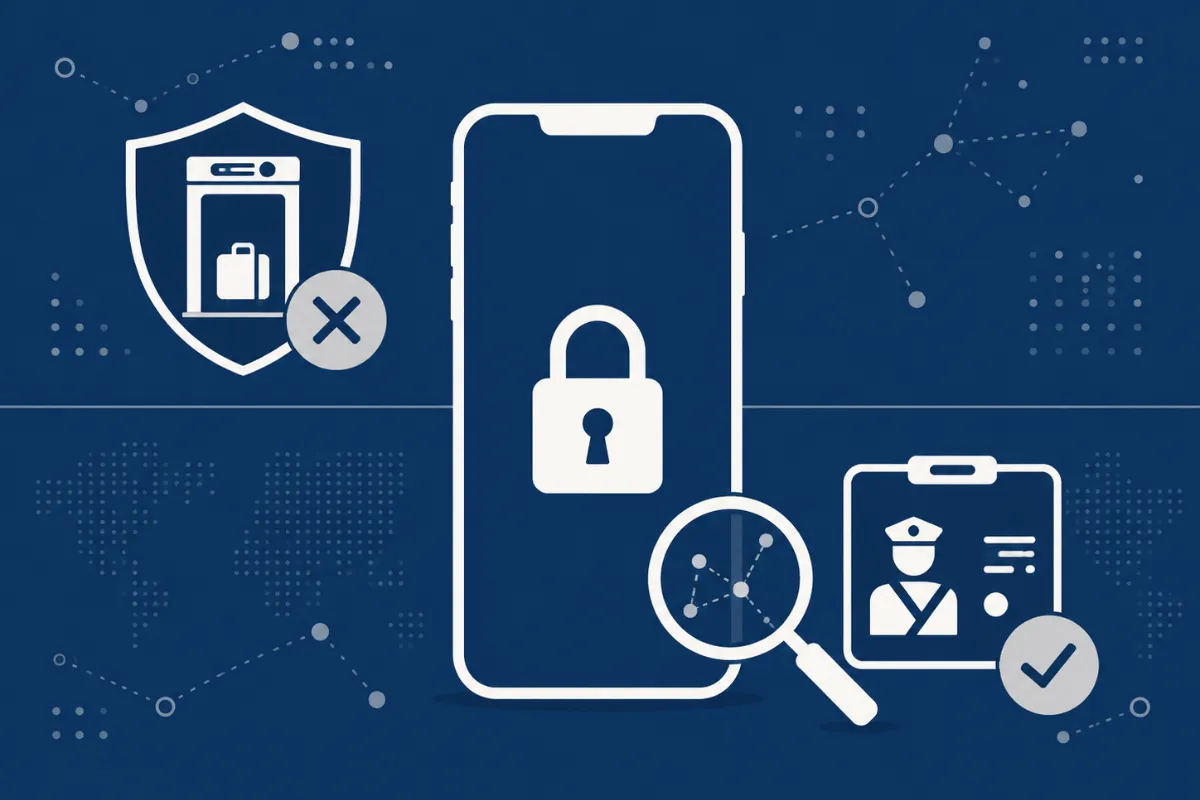
Direct Answer: No TSA officers do not have authority to search the digital contents of your phone at airport security checkpoints. However, U.S. Customs and Border Protection (CBP) agents can search your phone without a warrant when you cross an international border, including at airports. The distinction between these two agencies matters more than most travelers realize.
Can TSA search your phone when you’re standing in that security line, shoes off, laptop out, wondering if the agent is about to scroll through your camera roll? It’s a fear that has grown louder in recent years, especially as reports of device searches at airports make headlines. But the reality is more specific and more reassuring than the rumors suggest. The key is understanding which federal agency is involved, because TSA and CBP operate under different legal rules. If questions about government access to your devices concern you, our breakdown of whether police can access your phone without a warrant covers the broader picture.
The Short Version
- TSA screens for physical threats to aviation safety. Officers cannot search your phone’s data, and the agency has publicly stated it does not request access to passengers’ devices.
- CBP (Customs and Border Protection) is a separate agency that can search your phone without a warrant when you enter or leave the United States.
- In FY 2025, CBP conducted 55,318 electronic device searches, but that still represented less than 0.01% of international travelers.
- In the United Kingdom, border officers also hold powers to inspect devices under the Terrorism Act 2000 and the Border Security, Asylum and Immigration Act 2025.
What “Can TSA Search Your Phone” Actually Means Under the Law
The confusion around airport phone searches comes from mixing up two very different federal agencies.
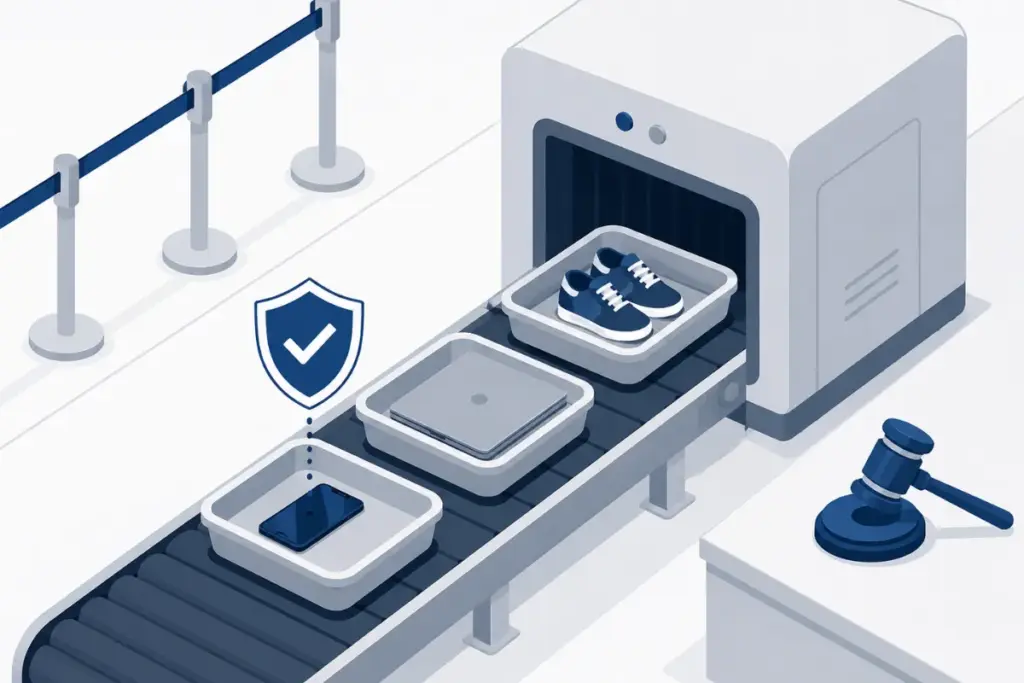
TSA’s authority is limited to physical security. The Transportation Security Administration was created by the Aviation and Transportation Security Act (2001) to prevent dangerous items from getting onto aircraft. TSA officers may ask travelers to power on their phones, place devices in screening bins, and even swab a phone’s surface for trace chemicals. But none of that involves looking at what’s stored on the device. A TSA spokesperson has confirmed publicly that the agency “does not request access to passengers’ electronic devices.”
CBP operates under the border search exception. Under longstanding U.S. law, the Fourth Amendment’s warrant requirement does not fully apply at international borders. CBP agents can conduct what the agency calls a “basic search” manually reviewing photos, messages, and apps on a device without any suspicion at all. An “advanced search,” which involves connecting the device to forensic equipment to copy or analyze data, requires reasonable suspicion of a legal violation or a national security concern, plus supervisor approval from a Grade 14 or higher official.
CBP updated its electronic device search policy in a January 2026 directive (Directive 3340-049B). The revised rules expanded the list of covered devices to include smartwatches, GPS systems, SIM cards, and vehicle infotainment systems. The directive also broadened the categories of violations that justify searches beyond terrorism to include firearms smuggling, export-controlled data, and proprietary theft.
The Supreme Court’s role. In Riley v. California (2014), the U.S. Supreme Court ruled unanimously that police generally need a warrant to search a phone seized during an arrest. Chief Justice Roberts wrote that the data on a phone “implicates privacy concerns far beyond” what a physical search of pockets or wallets would reveal. However, Riley applies to domestic law enforcement it does not override CBP’s separate border search authority.
In the United Kingdom, border officers at ports and airports can stop, question, and search individuals including their electronic devices under Schedule 7 of the Terrorism Act 2000. This power does not require prior suspicion. Under the Regulation of Investigatory Powers Act (RIPA), refusing to provide a password or passcode when lawfully requested can itself be a criminal offense in the UK. The Border Security, Asylum and Immigration Act 2025 introduced additional powers starting in January 2026, allowing officers to seize phones and SIM cards from certain arrivals suspected of involvement in smuggling networks.
In the European Union, member states generally follow stronger digital privacy protections under the General Data Protection Regulation (GDPR) and national constitutional provisions. Border officers in most EU countries face higher legal thresholds before searching electronic devices compared to the U.S. or UK, though specific rules vary by country.
Real-World Examples
Scenario 1: Domestic flight within the U.S. A traveler flying from New York to Los Angeles passes through a TSA checkpoint. An officer asks the traveler to place their phone in a bin and power it on. The officer checks that the phone is a functioning device. That is the end of the interaction the officer has no authority to open apps, read messages, or look at photos.
Scenario 2: Returning to the U.S. from an international trip. A U.S. citizen flies home from London and goes through CBP inspection. A CBP officer asks to see the traveler’s phone and begins scrolling through recent photos and messages. This is a basic search, and the officer does not need a warrant or any specific reason. If the traveler refuses to hand over the device, CBP cannot deny a U.S. citizen entry to the country but the agency can confiscate the phone for further examination. One traveler reported on Reddit that after refusing to provide a passcode, CBP held their device for 18 months, obtained a warrant, and downloaded its entire contents.
Scenario 3: Entering the UK from abroad. A traveler arriving at Heathrow is stopped under Schedule 7 of the Terrorism Act. A Border Force officer asks the traveler to provide their phone passcode. Under UK law, refusing this request can result in criminal charges under RIPA, regardless of whether the traveler has done anything wrong.
What People in This Situation Typically Do
- Back up and remove sensitive data before international travel. Many frequent travelers keep minimal personal data on devices they carry across borders. Some use a secondary “travel phone” with only essential apps.
- Log out of cloud accounts. CBP’s authority generally applies to data stored on the device, not to content accessible only through cloud services. Logging out of email, social media, and cloud storage apps before arriving at a border reduces the amount of information available during a search.
- Know which agency is involved. If an officer at a security checkpoint asks to look through a phone’s contents, travelers often ask for clarification about whether the officer is TSA or CBP. This distinction determines the legal authority behind the request.
- Document any search that occurs. Many civil liberties organizations recommend noting the officer’s name, badge number, date, time, and what was searched. Travelers can file complaints with TSA through the agency’s website or with CBP through the DHS Traveler Redress Inquiry Program (DHS TRIP).
- Power on devices before reaching security. Both TSA and CBP may ask travelers to prove that a device is functional. A dead phone that cannot be powered on may trigger additional screening or, in some cases, prevent the device from being brought through a checkpoint.
Tools That Can Help
- NordVPN A VPN (virtual private network) encrypts internet traffic, adding a layer of privacy on public airport Wi-Fi. It won’t prevent a physical device search, but it protects data in transit.
Related Articles
- Facial Recognition Technology: Where Is It Legal?
- Biometric Data Laws: Fingerprints and Face Scans
- Can Police Access Your Phone Without a Warrant?
Frequently Asked Questions
Does TSA need a warrant to search your phone? TSA does not search phone contents at all, so the warrant question doesn’t apply to them. TSA’s role is limited to physical security screening checking that devices are not concealed threats. If any law enforcement officer wanted to search a phone’s data at a domestic checkpoint, the Riley v. California (2014) ruling would generally require a warrant.
What happens if I refuse to give my phone passcode at the border? It depends on your status. Under U.S. law, CBP cannot deny a U.S. citizen entry to the country for refusing to provide a passcode. However, CBP can confiscate the device and hold it for further examination sometimes for weeks or months. Non-citizens, including green card holders, face higher stakes. Refusing a lawful request could lead to extended detention, denial of entry, or additional questioning. In the UK, refusing to provide a passcode when lawfully requested under Schedule 7 of the Terrorism Act can result in criminal prosecution.
Can CBP (border agents) search your phone differently than TSA? Yes completely differently. TSA and CBP are separate agencies with different legal authority. TSA focuses on preventing physical threats to aviation and does not access phone data. CBP operates under the border search exception to the Fourth Amendment, which grants broad authority to inspect people and property ncluding electronic devices at international borders without a warrant. CBP conducted over 55,000 device searches in FY 2025.
How do I protect my phone before traveling internationally? Many travelers take practical steps like backing up data and then removing it from the device, logging out of cloud-based apps, using strong encryption and a complex passcode, and carrying only the data they actually need for the trip. Some travelers use a dedicated travel device with minimal personal information. Civil liberties organizations also recommend knowing your rights before you travel and documenting any searches that occur.
The question of whether TSA can search your phone ultimately has a clear answer: no, TSA does not have that authority. The real concern for travelers particularly those crossing international borders is CBP and its broad powers under the border search exception. Understanding the difference between these two agencies is the single most practical thing a traveler can do to protect their digital privacy at the airport.
This article is for educational purposes only and does not constitute legal advice. Laws vary by jurisdiction and change frequently. For advice specific to your situation, consult a qualified attorney.
Sources & Further Reading
- CBP Border Search of Electronic Devices at Ports of Entry Official CBP policy page with statistics and FAQs on device searches
- TSA Security Screening TSA’s official procedures for passenger and baggage screening
- Riley v. California, 573 U.S. 373 (2014) Supreme Court ruling requiring warrants for phone searches incident to arrest
- UK Terrorism Act 2000 Schedule 7 UK legislation governing examination powers at ports and borders
- CBP Directive 3340-049B (January 2026) Updated CBP directive on electronic device searches