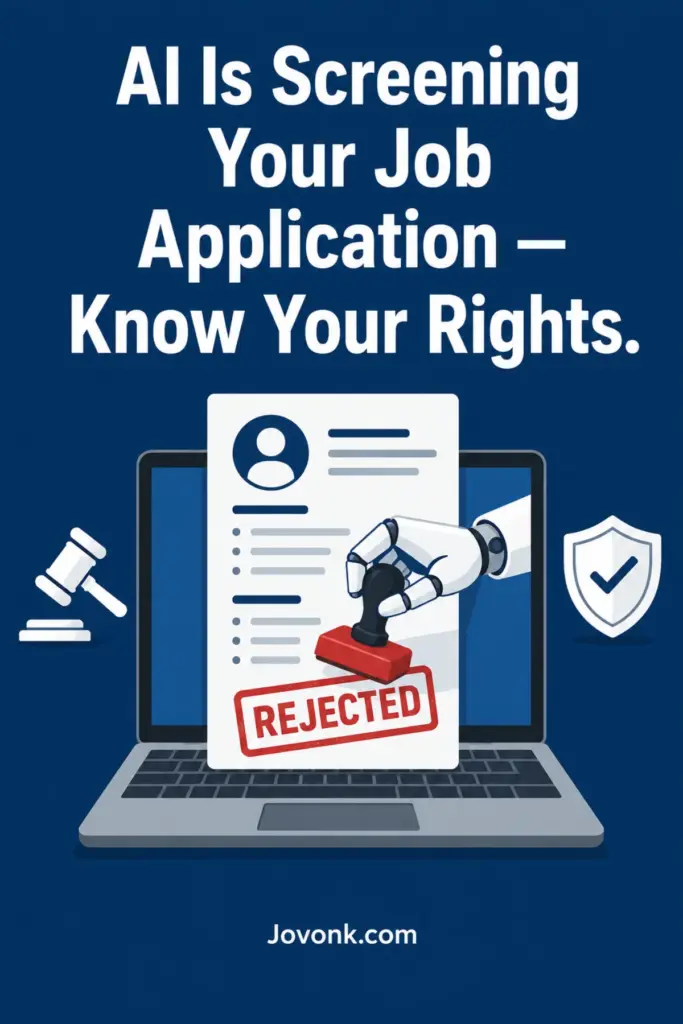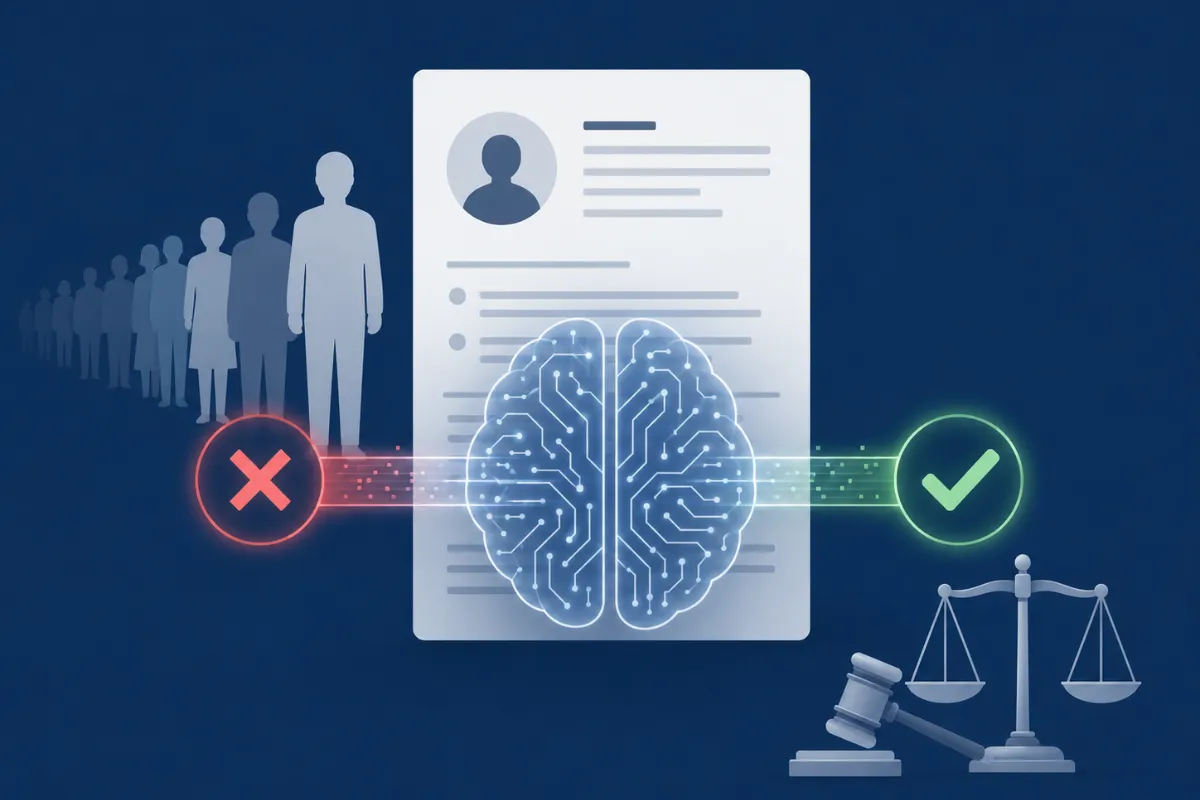
Direct Answer: Yes, AI is screening job applications at scale and yes, anti-discrimination laws still apply. In the US, EU, and UK, employers are legally responsible for biased outcomes produced by AI hiring tools, even if the bias was unintentional. Several new laws and landmark lawsuits are now giving job applicants concrete ways to push back.
AI used in hiring discrimination is one of the fastest-growing legal issues in employment law. Picture this: you tailor your resume, hit “apply,” and get a rejection email at 2 a.m. on a Sunday. No human ever read your application. An algorithm scored it, ranked it, and tossed it sometimes within minutes. If that algorithm carried built-in biases against your age, race, or disability, how would you know? Here’s what the law says across three major jurisdictions. What does the EU AI Act mean for AI like this?
The Short Version
- AI hiring tools including resume screeners, video interview analyzers, and candidate ranking systems can replicate and scale human biases baked into their training data.
- In the US, existing federal laws like Title VII, the ADA, and the ADEA already cover AI-driven hiring decisions. New state laws in California, Illinois, New York City, and Colorado add specific audit, notice, and transparency rules.
- The EU AI Act classifies AI hiring tools as “high-risk,” meaning they face mandatory bias testing, human oversight, and documentation requirements.
- In the UK, the Equality Act 2010 holds employers liable for discriminatory AI outcomes, and the ICO has flagged widespread non-compliance among employers using AI in recruitment.
How AI Used in Hiring Discrimination Actually Works Under the Law
United States
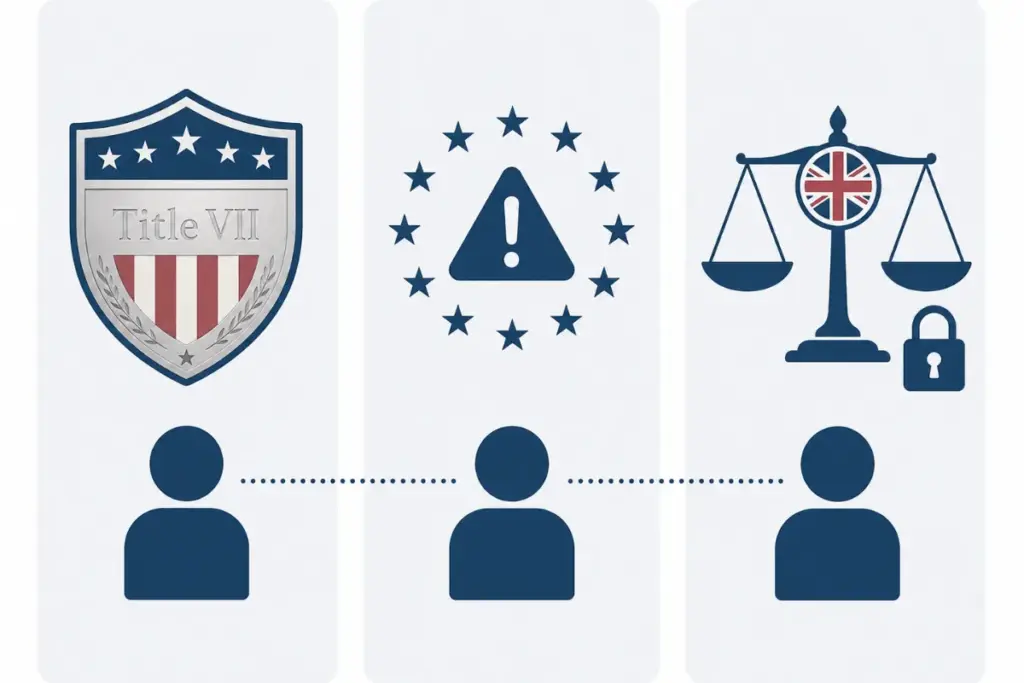
There is no single federal “AI hiring law” in the US. Instead, existing anti-discrimination statutes apply to AI-driven decisions the same way they apply to human ones.
The Equal Employment Opportunity Commission (EEOC) has made clear that using an algorithm does not reduce an employer’s legal obligations. Under Title VII of the Civil Rights Act, if an AI tool produces outcomes that disproportionately exclude a protected group by race, gender, religion, or national origin the employer faces disparate impact liability. The employer must then prove the practice is job-related and consistent with business necessity. If it can’t, the tool is unlawful.
The Americans with Disabilities Act (ADA) adds another layer. AI tools can violate the ADA by screening out candidates based on disability-related traits, conducting what amounts to a medical exam before a job offer, or failing to provide reasonable alternatives for applicants who can’t interact with the AI system.
Beyond federal law, states are moving quickly:
New York City’s Local Law 144 (effective July 2023) requires annual bias audits by independent auditors for any automated employment decision tool used in hiring. Employers must post audit results publicly and notify candidates at least 10 business days before using the tool.
California’s FEHA regulations (effective October 2025) make it unlawful to use any automated decision system (ADS) that discriminates based on protected traits. Employers must test for bias, keep records for at least four years, and provide alternative assessments when needed.
Illinois House Bill 3773 (effective January 2026) treats AI-driven discrimination as a civil rights violation under the Illinois Human Rights Act even when the bias is unintentional. Employers must also notify candidates when AI is used in hiring decisions.
Colorado’s AI Act (effective June 2026) targets “high-risk” AI systems, including those used in hiring, and requires employers to take reasonable care to prevent algorithmic discrimination.
European Union
Under the EU AI Act (Regulation 2024/1689), AI systems used in recruitment and hiring are classified as high-risk under Annex III, Section 4. This means any tool that screens resumes, ranks candidates, scores interviews, or targets job advertisements falls under strict compliance requirements.
Employers using these tools (called “deployers” under the Act) must provide human oversight, inform candidates that AI is being used, maintain detailed documentation, and conduct bias testing. Fines for non-compliance can reach €15 million or 3% of global annual turnover and for prohibited practices, up to €35 million or 7% of turnover.
The original deadline for high-risk system obligations was August 2, 2026. However, the Digital Omnibus package endorsed by the European Parliament in June 2026 pushes the compliance deadline for employment-related AI systems to December 2, 2027.
The EU also banned certain AI practices in employment starting February 2025, including emotion recognition in the workplace.
United Kingdom
The UK does not yet have a dedicated AI hiring law. Instead, the Equality Act 2010 provides the main legal framework. Under this Act, if an AI tool produces outcomes that disproportionately disadvantage people based on any of the nine protected characteristics age, disability, gender reassignment, marriage and civil partnership, pregnancy and maternity, race, religion or belief, sex, and sexual orientation that outcome may constitute indirect discrimination.
Critically, “the algorithm made the decision” is not a valid defense in a UK Employment Tribunal. The employer not the software vendor is liable.
The Information Commissioner’s Office (ICO) published its “Recruitment Rewired” report in March 2026, finding that most UK employers using AI in recruitment are likely making solely automated decisions without meaningful human involvement even when they believe a human has the final call. The ICO contacted 16 organizations it found to be operating outside UK data protection law.
Under UK GDPR (as amended by the Data (Use and Access) Act 2025), candidates have the right to challenge fully automated decisions and request human review.
Real-World Examples
Mobley v. Workday (US, ongoing): Derek Mobley, a Black IT professional over 40 with a disability, submitted more than 100 applications through companies using Workday’s AI-powered hiring platform. He was rejected every time sometimes within minutes, often during odd hours, indicating automated processing. In May 2025, a federal judge certified the case as a nationwide class action under the ADEA. The court ruled that Workday could be treated as an “agent” of employers, meaning software vendors not just the companies that hire them can be held liable. The case is now in the discovery phase as of mid-2026.
Harper v. SiriusXM (US, ongoing): Arshon Harper, a Black applicant, alleges that SiriusXM’s AI screening tool rejected approximately 150 of his job applications using proxies for race such as educational background and ZIP code to filter candidates.
ICO Recruitment Audits (UK, 2024–2026): A November 2024 ICO audit found that several AI recruitment tool providers were filtering candidates based on characteristics that amount to protected attributes under the Equality Act including gender, race, and sexual orientation often without candidates’ knowledge.
What People in This Situation Typically Do
- Check for signs of automation. Rejection emails sent at odd hours, within minutes of applying, or with generic language often indicate an AI-driven process.
- Request disclosure. In the US (New York City, Illinois, California, Colorado) and the EU, candidates increasingly have a legal right to know whether AI was used. In the UK, candidates can request this information under UK GDPR’s transparency provisions.
- File a complaint. In the US, complaints go to the EEOC (federal) or the relevant state agency. In the EU, complaints go to the national data protection authority or the market surveillance authority for the AI Act. In the UK, complaints go to the ICO for data protection issues and to the Employment Tribunal for discrimination claims.
- Document everything. Saving application confirmations, rejection emails, timestamps, and job listing details is important especially if a pattern of rejection across many applications appears.
- Consult an attorney. Class actions like Mobley v. Workday make it possible for individuals to join existing cases rather than filing alone.
Related Articles
- The EU AI Act Explained For Regular People
- Who Owns AI-Generated Content?
- Deepfakes: What’s Illegal and What’s Not
Frequently Asked Questions
Can an employer legally use AI to reject my job application?
Yes using AI in hiring is not itself illegal in the US, EU, or UK. But the results must not discriminate based on protected characteristics like race, age, gender, or disability. If the tool produces biased outcomes, the employer is legally responsible, regardless of whether a human reviewed the decision afterward.
How do I know if AI was used in my hiring process?
Look for signs like instant or off-hours rejections, generic response language, and lack of personalized feedback. Under New York City’s Local Law 144, Illinois HB 3773, and the EU AI Act, employers are required to notify candidates when AI is involved. In the UK, candidates can request this information under UK GDPR transparency rights.
Can I sue if AI discriminated against me in hiring?
In the US, filing a charge with the EEOC is typically the first step before pursuing a lawsuit under Title VII, the ADEA, or the ADA. Class actions like Mobley v. Workday are creating pathways for groups of affected applicants. In the UK, claims go through the Employment Tribunal under the Equality Act 2010. In the EU, enforcement varies by member state but can include complaints to data protection authorities and national courts.
Does the EU AI Act protect against AI hiring discrimination?
Yes. The EU AI Act classifies hiring-related AI as “high-risk,” which means providers and employers must conduct bias testing, maintain human oversight, and document how the tool works. Fines for violations can reach up to €35 million. Full enforcement of these obligations for employment AI is expected by December 2027, following a legislative deferral from the original August 2026 deadline.
The legal landscape around AI used in hiring discrimination is shifting rapidly but the core principle remains constant. Whether an employer uses a human recruiter or an algorithm, anti-discrimination laws apply. The difference today is that lawmakers, regulators, and courts across the US, EU, and UK are catching up to the technology and the protections for job applicants are getting stronger.
This article is for educational purposes only and does not constitute legal advice. Laws vary by jurisdiction and change frequently. For advice specific to your situation, consult a qualified attorney.
Sources & Further Reading
- EEOC The Americans with Disabilities Act and the Use of Software, Algorithms, and Artificial Intelligence Federal guidance on how the ADA applies to AI hiring tools
- EUR-Lex Regulation (EU) 2024/1689 (EU AI Act) Full text of the EU AI Act, including Annex III high-risk classifications
- ICO Guidance on AI and Data Protection: Fairness, Bias and Discrimination ICO guidance on fairness and bias in AI systems under UK law
- California Civil Rights Department AI Employment Discrimination Regulations California’s approved regulations on automated decision systems in employment
- Congress.gov Title VII of the Civil Rights Act of 1964 The foundational US federal anti-discrimination statute