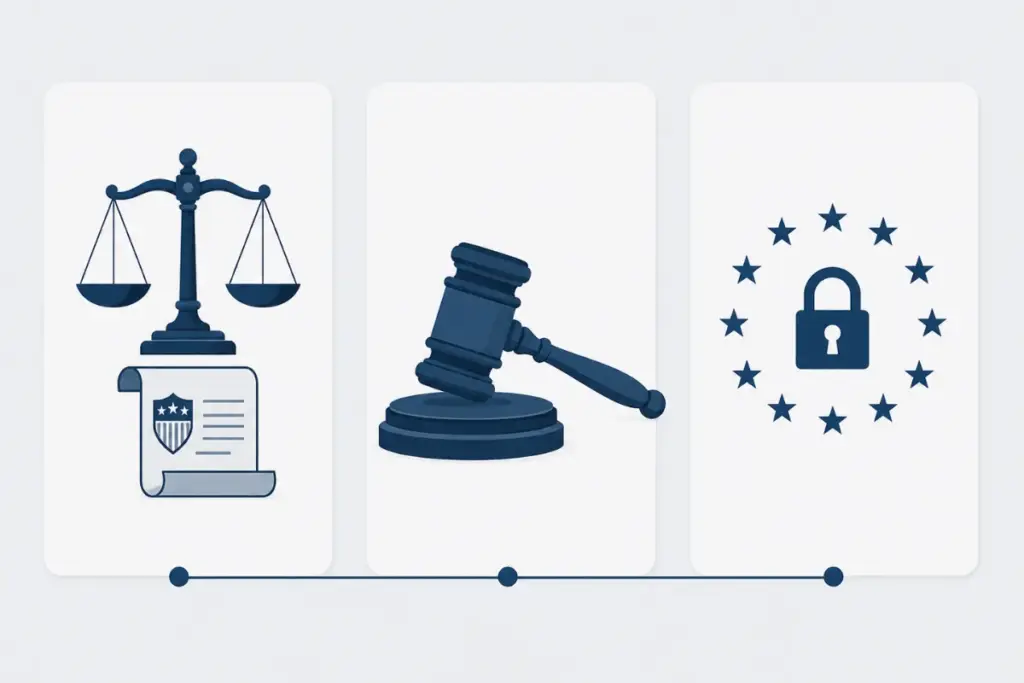
Direct Answer: In the United States, police generally need a warrant to search the data on your phone, thanks to the landmark Supreme Court ruling in Riley v. California (2014). In the UK, officers can seize a phone under PACE 1984, but accessing its data usually requires separate legal authority. Across the EU, the Charter of Fundamental Rights treats phone data as protected personal information, and access by law enforcement typically requires judicial authorization.
Can police access your phone data without permission and what happens if they try? Picture this: you’re pulled over for a traffic violation, and the officer asks to look through your phone. Or maybe you’ve been arrested, and the police want to scroll through your messages, photos, and location history. It’s a situation millions of people worry about, and the answer depends heavily on where you live and what the circumstances are. Understanding your phone search rights starts with knowing what the law actually says in your jurisdiction and the rules have changed significantly in recent years. If you’re interested in the broader picture of government surveillance and personal data, our article on Facial Recognition Technology: Where Is It Legal? covers another fast-moving area of digital search and seizure.
The Short Version
- In the US, the Supreme Court ruled unanimously in 2014 that police need a warrant to search your phone even during a lawful arrest.
- In the UK, police can physically seize your phone, but extracting data from it is a separate legal step that generally requires a warrant or your consent.
- Across the EU, accessing phone data is treated as a serious interference with fundamental rights and typically requires prior judicial authorization.
- Whether police can force you to open your phone with a fingerprint or face scan is still legally unsettled in the US, with federal courts split on the issue.
Can Police Access Your Phone Data? Here’s What the Law Says
To understand whether police can access your phone data, it helps to look at where old laws meet new technology. A smartphone contains more personal information than almost anything else a person carries messages, photos, browsing history, location data, financial records, and health information. Courts in multiple countries have recognized that searching a phone is fundamentally different from searching a wallet or a bag.
United States: The Fourth Amendment and Riley v. California
The Fourth Amendment to the US Constitution protects people against unreasonable searches and seizures. For decades, police could search items found on a person during a lawful arrest a pack of cigarettes, a notebook, a wallet without needing a separate warrant. The question was whether that rule extended to cell phones.
In 2014, the Supreme Court answered that question unanimously in Riley v. California. Chief Justice John Roberts wrote that modern cell phones are not just another item someone carries. The Court compared the difference between searching a physical object and searching a phone to the difference between a horseback ride and a flight to the moon. The ruling was clear: police must get a warrant before searching the digital contents of a phone, even during a lawful arrest.
The only exception is exigent circumstances genuine emergencies where there’s an immediate threat to life or a real risk that evidence is about to be destroyed. Outside of those narrow situations, the rule holds: get a warrant first.
Four years later, the Supreme Court extended digital privacy protections further in Carpenter v. United States (2018). That case dealt with cell-site location information (CSLI) the records wireless carriers collect every time your phone connects to a cell tower. The FBI had obtained 127 days of location data for a robbery suspect without a warrant. The Court ruled 5-4 that accessing historical location records is a Fourth Amendment search, and police need a warrant supported by probable cause to obtain them.
United Kingdom: PACE 1984 and the Data vs. Device Distinction
In England and Wales, the Police and Criminal Evidence Act 1984 (PACE) is the primary law governing police searches. Under Section 19 of PACE, officers can seize a phone if they have reasonable grounds to believe it contains evidence of a crime. But UK courts have drawn an important line between seizing the physical device and accessing the data stored on it.
The Court of Appeal confirmed this distinction in R v. Bater-James and Mohammed (2020), holding that data extraction is a more intrusive step that generally requires either consent or a warrant. Accessing data engages both PACE and the Investigatory Powers Act 2016.
In 2026, the Crime and Policing Act introduced an explicit power for law enforcement to access specified online accounts linked to a seized device, but this requires authorization by a senior officer and is subject to a statutory code of practice.
One critical detail for the UK: under Section 49 of the Regulation of Investigatory Powers Act 2000 (RIPA), police can issue a formal notice compelling you to hand over your phone’s passcode or encryption key. Refusing to comply with a valid Section 49 notice is a criminal offense that can carry up to two years in prison or five years in cases involving national security or child exploitation.
European Union: Fundamental Rights and Judicial Oversight
In the EU, the right to data protection is a fundamental right under Article 8 of the Charter of Fundamental Rights. The Law Enforcement Directive (Directive 2016/680) specifically governs how police can process personal data during criminal investigations.
The European Court of Justice (ECJ) has ruled that full and uncontrolled access to all data on a mobile phone constitutes a serious interference with fundamental rights. According to the ECJ, such access must be subject to prior review by a court or independent body, except in cases of genuine urgency. Even then, the review must happen within a short time.
Each EU member state implements these principles through its own national laws, so the specific procedures vary from country to country. But the core principle is consistent: accessing phone data is not routine, and it demands proportionality, necessity, and independent oversight.
What About Border Crossings?
Border searches are a major exception to the general warrant requirement. In the United States, the border search exception gives federal agents including Customs and Border Protection (CBP) broad authority to search travelers and their belongings at airports, land borders, and ports of entry. This authority has historically been interpreted to include electronic devices.
However, the extent of that authority for phone data remains contested. CBP policy distinguishes between a “basic search” (manually scrolling through a phone) and an “advanced search” (connecting the device to external equipment to extract data). Advanced searches require reasonable suspicion of a legal violation. Several federal courts are considering whether the Riley and Carpenter rulings should limit warrantless border phone searches, but no definitive Supreme Court ruling exists on this point yet.
In the UK, the Border Security, Asylum and Immigration Act 2025 granted specific powers for officers to examine electronic devices at ports and borders, including the authority to access online accounts linked to a seized device. These powers are subject to a statutory code of practice and senior officer authorization.
Across the EU, border phone searches must still comply with the Charter of Fundamental Rights. However, individual member states have varying rules about what border agents can and cannot do with electronic devices, and travelers moving between EU and non-EU countries face different standards depending on the direction of travel.
The Cloud Data Question
One of the most common questions people ask is this: can police access your phone data by going around the device entirely requesting it from cloud providers like Apple, Google, or Microsoft instead?
In the US, the Stored Communications Act (SCA) and the CLOUD Act (2018) govern this process. Under the SCA, law enforcement generally needs a warrant for the contents of stored communications like emails and messages. The CLOUD Act clarified that US-based providers must comply with valid US warrants regardless of where the data is physically stored even on servers in other countries. This means if a person’s iCloud backup sits on a server in Ireland, US authorities can still compel Apple to produce it with a proper warrant.
In the UK, cross-border access to cloud data often involves Mutual Legal Assistance Treaties (MLATs) and the UK-US bilateral data access agreement signed under the CLOUD Act framework. UK law enforcement can also seek production orders through domestic courts for data held by UK-based providers.
Understanding how and when police can access your phone data whether from the device itself or from the cloud is critical for anyone who stores personal information digitally, which in practice means nearly everyone with a smartphone.
Real-World Examples
The Traffic Stop That Changed Everything (US)
David Leon Riley was pulled over in San Diego for expired registration tags. Officers found loaded guns in his car and arrested him. During the arrest, they searched his smartphone without a warrant and found photos and messages connecting him to an earlier gang-related shooting. Riley was convicted partly based on that evidence. His case went all the way to the Supreme Court, which ruled the phone search was unconstitutional. The message from the Court was direct: if police want to search your phone, they need a warrant.
The 127-Day Tracking Case (US)
Timothy Carpenter was suspected of involvement in a string of armed robberies. The FBI obtained 12,898 location data points from his wireless carrier covering 127 days of his movements without a warrant. The data placed his phone near four robbery locations. The Supreme Court ruled that collecting this volume of location data without a warrant violated the Fourth Amendment, calling cell phones “such a pervasive and insistent part of daily life” that the old rules about voluntarily shared information no longer applied.
The Passcode Standoff (UK)
In the UK, individuals who refuse to provide a phone passcode after receiving a valid Section 49 notice under RIPA face criminal prosecution. Several cases have resulted in prison sentences for refusal alone, separate from any underlying crime being investigated. The law treats the failure to disclose an encryption key as a standalone offense.
What People in This Situation Typically Do
If law enforcement asks to search a phone, many people follow a set of practical steps. These are based on how the law currently works in the US, UK, and EU not on what any one person “should” do, since every situation is different.
- Stay calm and identify the situation. Understanding whether this is a routine traffic stop, an arrest, or a border crossing matters because different legal rules apply in each context.
- Know that silence is generally protected. In the US, individuals are not typically required to provide a passcode. Courts have generally treated passcodes as testimonial meaning they reveal the contents of your mind and therefore protected by the Fifth Amendment. In the UK, however, a formal Section 49 notice can legally compel disclosure.
- Ask whether there is a warrant. In the US, officers need a warrant to search phone data unless exigent circumstances exist. Politely asking whether a warrant has been obtained is within a person’s rights.
- Document what happens. If a phone is seized, noting the time, location, officer’s name, and what was said can be valuable later.
- Contact a lawyer. Many legal aid organizations and criminal defense attorneys advise people to speak with a lawyer before consenting to any search. Consent, once given, can be difficult to take back.
- Understand the biometric question. In the US, courts are currently split on whether police can compel a fingerprint or face scan to open a phone. The Ninth Circuit ruled in 2024 that physically pressing a suspect’s thumb to a phone is not a Fifth Amendment violation. But the D.C. Circuit ruled in early 2025 that ordering someone to use their fingerprint to access their phone does violate the Fifth Amendment. Until the Supreme Court resolves this split, outcomes depend on jurisdiction.
Tools That Can Help
While no tool replaces legal advice, certain privacy tools can add a layer of protection to personal data:
- NordVPN Encrypts internet traffic and masks IP address activity, which can limit the data available to third parties and service providers. Particularly relevant for people concerned about network-level surveillance.
Related Articles
- Biometric Data Laws: Fingerprints & Face Scans How the law treats fingerprint and facial recognition data across the US, UK, and EU.
- Children’s Online Privacy (COPPA) Explained What federal law says about collecting data from minors, including phone data.
- What Is GDPR and Why Should You Care? The EU’s landmark privacy law and what it means for personal data protection.
Frequently Asked Questions
Can police force me to open my phone with my fingerprint?
It depends on where you live. US federal courts are split on this question. The Ninth Circuit ruled in 2024 that physically using a suspect’s fingerprint to open a phone did not violate the Fifth Amendment, treating it like a blood draw or a lineup. But the D.C. Circuit reached the opposite conclusion in early 2025, ruling that compelling someone to use biometrics to access a phone is a testimonial act. In the UK, police can issue a formal legal notice under RIPA compelling you to provide a passcode, but the law does not specifically address forced biometric access. This area of law is evolving rapidly.
What is a digital warrant and how does it work?
A digital warrant is a court order that authorizes law enforcement to search electronic devices or digital accounts. In the US, police must show probable cause specific facts suggesting evidence of a crime will be found to a judge, who then issues the warrant. The warrant must describe what is being searched and what evidence is being sought. In the UK, police apply for a warrant or production order from a magistrate or judge. Across the EU, similar judicial authorization is required. The key principle everywhere: it must be specific, not a blanket permission to browse through everything on a device.
Can police access my cloud data without a warrant?
This area is legally complex. In the US, the Stored Communications Act (SCA) and the CLOUD Act (2018) govern law enforcement access to cloud-stored data. Under the SCA, police generally need a warrant for the contents of stored communications. The CLOUD Act clarified that US-based providers like Apple, Google, and Microsoft must comply with US warrants even if the data is stored on servers outside the country. In the UK, accessing cloud data stored on foreign servers may require international cooperation through Mutual Legal Assistance Treaties. EU member states must comply with the Law Enforcement Directive when seeking access to cloud-stored personal data.
Does the Fourth Amendment protect my smartphone data?
Yes. The Supreme Court has ruled twice in Riley v. California (2014) and Carpenter v. United States (2018) that smartphone data receives full Fourth Amendment protection. In Riley, the Court held that police cannot search a phone during an arrest without a warrant. In Carpenter, the Court extended that protection to cell-site location records held by wireless carriers. The Fourth Amendment’s protection against unreasonable searches applies to digital data just as it applies to a person’s home, papers, and physical belongings.
The question of whether police can access your phone data has a much clearer answer today than it did a decade ago. Key Supreme Court rulings in the US, evolving PACE interpretations in the UK, and fundamental rights protections across the EU all point in the same direction: phone data is private, and law enforcement generally needs judicial authorization to access it. But gaps remain particularly around biometric access, border searches, and cloud-stored data. Knowing the rules that apply in your jurisdiction is the most practical step anyone can take to understand their rights in this area.
This article is for educational purposes only and does not constitute legal advice. Laws vary by jurisdiction and change frequently. For advice specific to your situation, consult a qualified attorney.
Sources & Further Reading
- Fourth Amendment U.S. Constitution The constitutional foundation for search and seizure protections in the United States.
- Riley v. California, 573 U.S. 373 (2014) Supreme Court Opinion The landmark ruling requiring warrants for cell phone searches.
- Carpenter v. United States, 585 U.S. 296 (2018) Supreme Court Opinion The ruling extending warrant requirements to cell-site location data.
- Police and Criminal Evidence Act 1984 (PACE) UK Legislation The primary statute governing police search powers in England and Wales.
- EU Charter of Fundamental Rights, Article 8 Protection of Personal Data The EU’s constitutional protection for personal data.