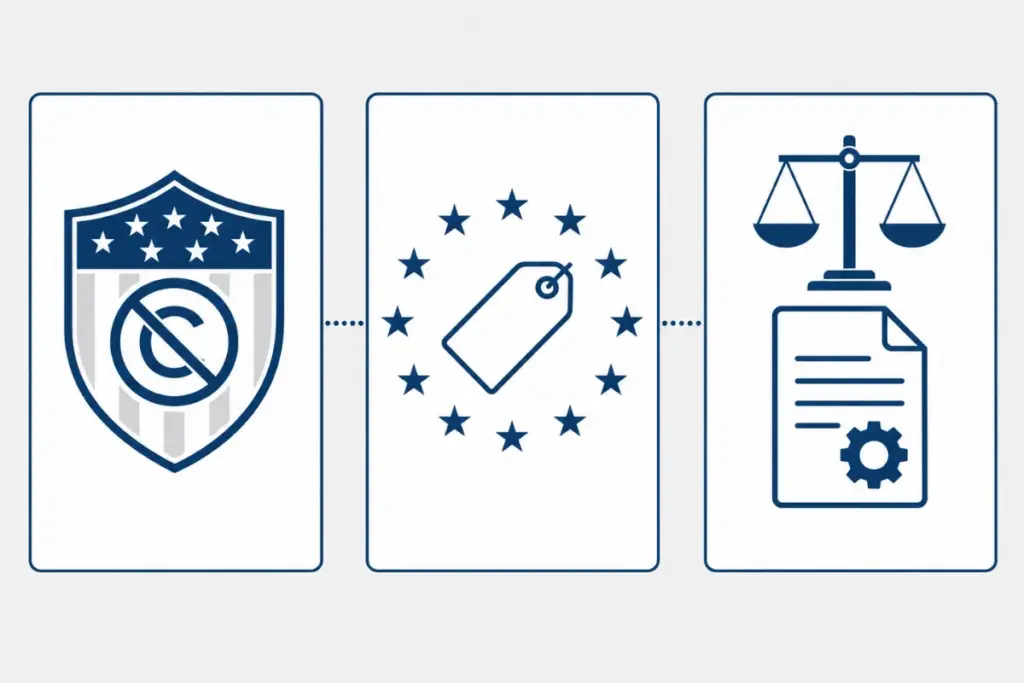
Direct Answer: Yes, AI-generated content can generally be used for commercial purposes but with major caveats. In the US, purely AI-generated work cannot be copyrighted, meaning anyone can copy it. In the EU, the AI Act (2024) requires labeling and transparency for AI-generated content. In the UK, the government has proposed removing copyright protection for purely AI-generated works altogether. The law does not ban selling AI content, but it also does not protect it the way it protects human-created work.
Is AI content legal for commercial use? That is the question keeping freelancers, marketers, and business owners up at night and the answer is not as simple as a yes or no. You may have already used ChatGPT to write product descriptions, or Midjourney to create marketing images. The content looks professional. It works. But can you legally sell it, trademark it, or claim it as your own? The rules depend on where you live, how much human creativity went into the work, and what you plan to do with it. If you are wondering who actually owns the output from these tools, that is a separate but related question covered in Who Owns AI-Generated Content?.
The Short Version
- Selling AI-generated content is not illegal in the US, EU, or UK but in most cases, you cannot copyright purely AI-generated work, which means competitors can freely copy it.
- The more human creativity you add to AI output, the stronger your legal protection becomes editing, arranging, and making real creative decisions matters.
- In the EU, transparency rules under the AI Act (2024) require AI-generated content to be labeled, and businesses face fines up to €15 million for violations starting August 2026.
- Trademark law works differently from copyright law AI-generated logos can potentially be trademarked in the US if they meet distinctiveness requirements, even when copyright protection is unavailable.
What the Law Actually Says About Commercial AI Content
The legal status of AI-generated content sits at the intersection of copyright law, trademark law, and new AI-specific regulations. The rules differ significantly between the US, EU, and UK. Here is how each jurisdiction handles it.
United States: No Copyright for Pure AI Output
The US position is now firmly established. On March 2, 2026, the Supreme Court declined to hear the appeal in Thaler v. Perlmutter, leaving intact lower court rulings that works created by AI without meaningful human involvement cannot be copyrighted.
The US Copyright Office the federal agency that registers copyrights has maintained this position since its February 2023 guidance: copyright protection requires human authorship. A prompt typed into ChatGPT or Midjourney, no matter how detailed, does not count as authorship if the AI system controls the creative expression of the final output.
But this does not mean all AI-involved work is unprotectable. The Copyright Office draws a clear line between two categories:
AI-generated work where the AI makes the creative decisions about composition, style, and expression. This cannot be copyrighted. If you type “a sunset over mountains in watercolor style” into an image generator and download the result, that image belongs to no one.
AI-assisted work where a human makes meaningful creative choices and uses AI as a tool. This can be copyrighted, but only the human-contributed portions receive protection. Think of a photographer who uses Adobe’s Generative Fill to edit specific parts of their own photo the original photograph and the creative editing decisions are protectable.
When registering AI-assisted work with the Copyright Office, applicants must disclose which elements were AI-generated and which were human-authored. Vague disclosures or overclaiming human authorship can invalidate the registration.
Here is the practical impact: you can legally sell AI-generated content. No law prohibits it. But without copyright protection, you have no legal tool to stop someone else from copying and reselling the same content. The work is effectively in the public domain meaning anyone can use it.
European Union: Transparency Rules and Copyright Requirements
The EU takes a different approach, focused more on regulating AI providers than on the copyright status of outputs.
The EU AI Act (2024), which is being phased in through 2026, creates specific obligations for companies building and using AI systems. Starting August 2, 2026, the transparency rules under Article 50 become fully enforceable. These require:
- AI-generated content including text, images, audio, and video to be clearly labeled as artificial.
- Providers of general-purpose AI models (the companies building tools like ChatGPT or Stable Diffusion) to publish summaries of copyrighted works used in their training data.
- Machine-readable watermarking of AI-generated outputs, so the content can be detected as AI-made even after editing.
Violations can trigger fines of up to €15 million or 3% of worldwide annual turnover, whichever is higher.
On the copyright side, the EU Copyright Directive allows creators to opt out of having their work used for AI training. AI developers must check whether a data source has a copyright reservation and either obtain a license or exclude that content. The European Parliament voted in March 2026 to push for even stronger transparency rules, calling the existing requirements “completely inadequate.”
For businesses selling AI content in the EU, the key takeaway is labeling. If you publish AI-generated text or images commercially without proper disclosure, you risk penalties once Article 50 enforcement begins.
The European Parliament has also stated that content fully generated by AI should not receive copyright protection aligning with the US position on that specific question.
United Kingdom: A Legal Framework in Transition
The UK sits in an unusual position. Under Section 9(3) of the Copyright, Designs and Patents Act 1988 (CDPA), the UK has historically offered copyright protection for computer-generated works (CGWs) granting 50 years of protection to the person who “made the arrangements necessary” for the work’s creation. In theory, this could cover someone who prompts an AI system.
However, on March 18, 2026, the UK government published its Report on Copyright and Artificial Intelligence and recommended removing Section 9(3). The government concluded that most other countries do not protect purely AI-generated works, and the provision was unclear and rarely relied upon.
If Section 9(3) is repealed which has not happened yet as of mid-2026 the UK would align with the US and EU: purely AI-generated works would lose copyright protection, while AI-assisted works with genuine human creative input would remain protectable under standard originality requirements.
The UK government also confirmed it will not introduce a broad text and data mining (TDM) exception for AI training. This means AI developers using copyrighted works to train models in the UK must obtain licenses unless an existing exception, like the non-commercial research exception under Section 29A CDPA, applies.
For businesses operating in the UK, the practical advice is the same: treat AI-generated content as potentially unprotectable and document any human creative contributions carefully.
Real-World Examples
The Freelance Writer Using AI for Blog Posts
Sarah runs a content agency. She uses ChatGPT to draft blog posts for clients, then rewrites, fact-checks, adds her own analysis, and restructures each piece. Her clients pay for the final product.
Legal reality: Sarah can sell this content. The AI-generated draft itself has no copyright protection in the US. But because Sarah makes substantial creative choices rewriting, restructuring, adding original analysis the final product likely qualifies as an AI-assisted work with protectable human contributions. She would be wise to keep records of her editing process.
The E-Commerce Seller Using AI Product Images
Marcus generates product mockup images using Midjourney for his online store. He downloads the outputs and uploads them directly to his listings.
Legal reality: Marcus can use these images commercially Midjourney’s terms of service grant paid subscribers commercial use rights. But those images likely have no copyright protection under US law. A competitor could screenshot the same images and use them without legal consequence. Marcus has no ability to send a cease-and-desist letter or file a copyright infringement claim, because there is no copyright to infringe.
The Startup Trying to Trademark an AI Logo
A fintech startup uses an AI logo generator to create its brand identity. The founders want to register the logo as a trademark with the USPTO (the US Patent and Trademark Office).
Legal reality: Trademark law operates differently from copyright law. The USPTO does not evaluate who created a logo it focuses on whether the mark is distinctive, whether it functions as a source identifier in commerce, and whether it conflicts with existing marks. An AI-generated logo can be trademarked if it meets these requirements. However, because AI tools are trained on existing designs, there is a higher risk of producing logos that resemble other registered marks. A trademark clearance search is critical before filing.
What People in This Situation Typically Do
- Check the platform’s terms of service first. Every AI tool has different rules about commercial use. OpenAI, Midjourney, Adobe Firefly, and Stable Diffusion each have their own licensing terms. Some free tiers restrict commercial use, while paid plans typically allow it. Terms change without notice screenshot and date-stamp the relevant sections before starting a commercial project.
- Add meaningful human creative input. The single most important factor in whether AI-involved work can be copyrighted is the level of human creative control. Many creators use AI outputs as starting points, then substantially edit, rearrange, modify, or build upon them. This is not just good legal practice it also produces better work.
- Document everything. Keep records of prompts, drafts, edits, and creative decisions. If a copyright dispute arises, this documentation is the evidence that establishes human authorship. The Copyright Office requires detailed disclosure of AI involvement when registering works.
- Disclose AI involvement when required. In the US, the FTC requires disclosure when AI use materially affects how consumers interpret content particularly in advertising and sponsored content. In the EU, Article 50 of the AI Act requires AI-generated content to be labeled. New York’s AI Disclosure Law, effective June 2026, requires disclosure when advertising content is substantially generated by AI, with penalties of $1,000 to $5,000 per violation.
- Consider trademark protection for brand assets. If you are using AI to create logos, brand names, or other identity elements, trademark registration may offer stronger protection than copyright for those specific assets. Trademarks protect brand identity in the marketplace, regardless of how the design was created.
- Get legal advice for high-stakes commercial use. If significant revenue depends on AI-generated content product images, marketing materials, commercial publications consulting an intellectual property attorney is worth the investment. The legal landscape is changing rapidly, and what is permissible today may require additional steps tomorrow.
Tools That Can Help
Since AI content commercial rights depend heavily on registration and documentation, these free official resources are a good starting point:
- US Copyright Office Registration Portal Register AI-assisted works with proper disclosure of AI-generated elements. Registration is required before filing an infringement lawsuit in the US.
- USPTO Trademark Search (TESS) Run a free trademark clearance search before filing for an AI-generated logo or brand name. Essential for spotting potential conflicts.
- EU AI Act Text and Guidance The European Commission’s official page for the AI Act, including implementation timelines and compliance guidance.
- UK IPO Copyright Guidance The March 2026 UK government report on copyright and AI, including the proposed removal of Section 9(3) CDPA.
Related Articles
- Who Owns AI-Generated Content? The pillar guide to AI copyright ownership across jurisdictions.
- The EU AI Act Explained For Regular People A plain-English breakdown of Europe’s landmark AI regulation and what it means for ordinary users.
- Deepfakes: What’s Illegal and What’s Not in 2026 Where the law draws the line on synthetic media, from political ads to entertainment.
Frequently Asked Questions
Can I sell products with AI-generated images?
Yes, selling products with AI-generated images is generally legal in the US, EU, and UK. Most paid AI image tools grant commercial use rights through their terms of service. However, those images likely cannot be copyrighted, so another business could use the same or similar images without legal consequence. The bigger risk is if the AI produces an image that closely resembles an existing copyrighted work or registered trademark in that case, the seller could face infringement claims from the original rights holder. Many sellers treat AI images as starting points and modify them substantially before commercial use.
Is using AI-written content for a paid blog legal?
Using AI-written content for a paid blog is legal. No law in the US, EU, or UK prohibits publishing or selling AI-generated text. The key concern is not legality but protectability. If you publish a blog post written entirely by AI, you likely cannot copyright it. A competitor could republish the exact same text without facing any legal claim. Many professional bloggers and content agencies use AI to generate first drafts, then rewrite, fact-check, and add original analysis creating AI-assisted work with stronger legal standing. In the EU, transparency rules under the AI Act may require labeling AI-generated content starting August 2026.
Do I need to disclose that content was AI-generated?
It depends on the jurisdiction and context. In the US, the FTC requires disclosure when AI use materially affects how consumers interpret content, especially in advertising and endorsements. New York’s AI Disclosure Law (effective June 2026) specifically requires disclosure when advertising content is substantially generated by AI. In the EU, Article 50 of the AI Act requires AI-generated content to be labeled, with enforcement starting August 2026. For general blog posts, articles, or creative work, no US federal law currently mandates blanket AI disclosure but platform policies on YouTube, Meta, and TikTok may require it for realistic synthetic media.
Can brands trademark AI-generated logos?
In the US, the USPTO evaluates trademarks based on distinctiveness and use in commerce not on who or what created the design. An AI-generated logo can be federally trademarked if it is distinctive enough to identify the source of goods or services, does not conflict with existing registered marks, and is used or intended to be used in commerce. The challenge is that AI tools often produce generic-looking designs trained on existing visual patterns, increasing the risk of similarity with other marks. A trademark clearance search is essential. Some trademark attorneys recommend using AI for initial concepts, then having a human designer create the final version to strengthen both copyright and trademark claims.
Conclusion
The question of whether is AI content legal for commercial use comes down to a simple distinction: legal to sell, but hard to protect. No law in the US, EU, or UK bans the commercial use of AI-generated content. But across all three jurisdictions, the trend is clear purely AI-generated work receives little or no copyright protection, while AI-assisted work with real human creative input sits on stronger legal ground. The EU is moving faster than any other region on transparency and labeling requirements. The US has settled the authorship question but left training data and platform liability to the courts. The UK is watching and waiting, though a significant change to its copyright framework appears likely.
For anyone using AI commercially, the practical path forward is the same everywhere: add genuine creative value, keep detailed records, check platform terms, and stay current as this area of law continues to change.
This article is for educational purposes only and does not constitute legal advice. Laws vary by jurisdiction and change frequently. For advice specific to your situation, consult a qualified attorney.
Sources & Further Reading
- US Copyright Office Copyright and Artificial Intelligence Official reports and registration guidance on AI-generated and AI-assisted works.
- Congressional Research Service Generative AI and Copyright Law Legal analysis of copyrightability and fair use questions in US law.
- European Commission AI Act Regulatory Framework Official EU page covering AI Act timelines, transparency obligations, and enforcement.
- UK Government Report on Copyright and Artificial Intelligence (March 2026) The UK’s statutory report on AI copyright policy, including the proposed repeal of Section 9(3) CDPA.
- European Parliament Protecting Copyrighted Work in the Age of AI (March 2026) Parliament’s position on AI-generated content and copyright training data transparency.